
Lumio's promise for the Aura 5 is anything but simple or easy. The new Hi-Fi speakers are sold with the notion, "Your Audiophile journey starts here". And I've been testing them for the last two weeks to answer whether that is correct.
While I'd really love for you to read the review in detail, I can tell you the answer in brief. Lumio has cooked something really impressive, but with a few rough edges that could stick out. It's positive for the most part, and I would recommend it for nine out of 10 users.
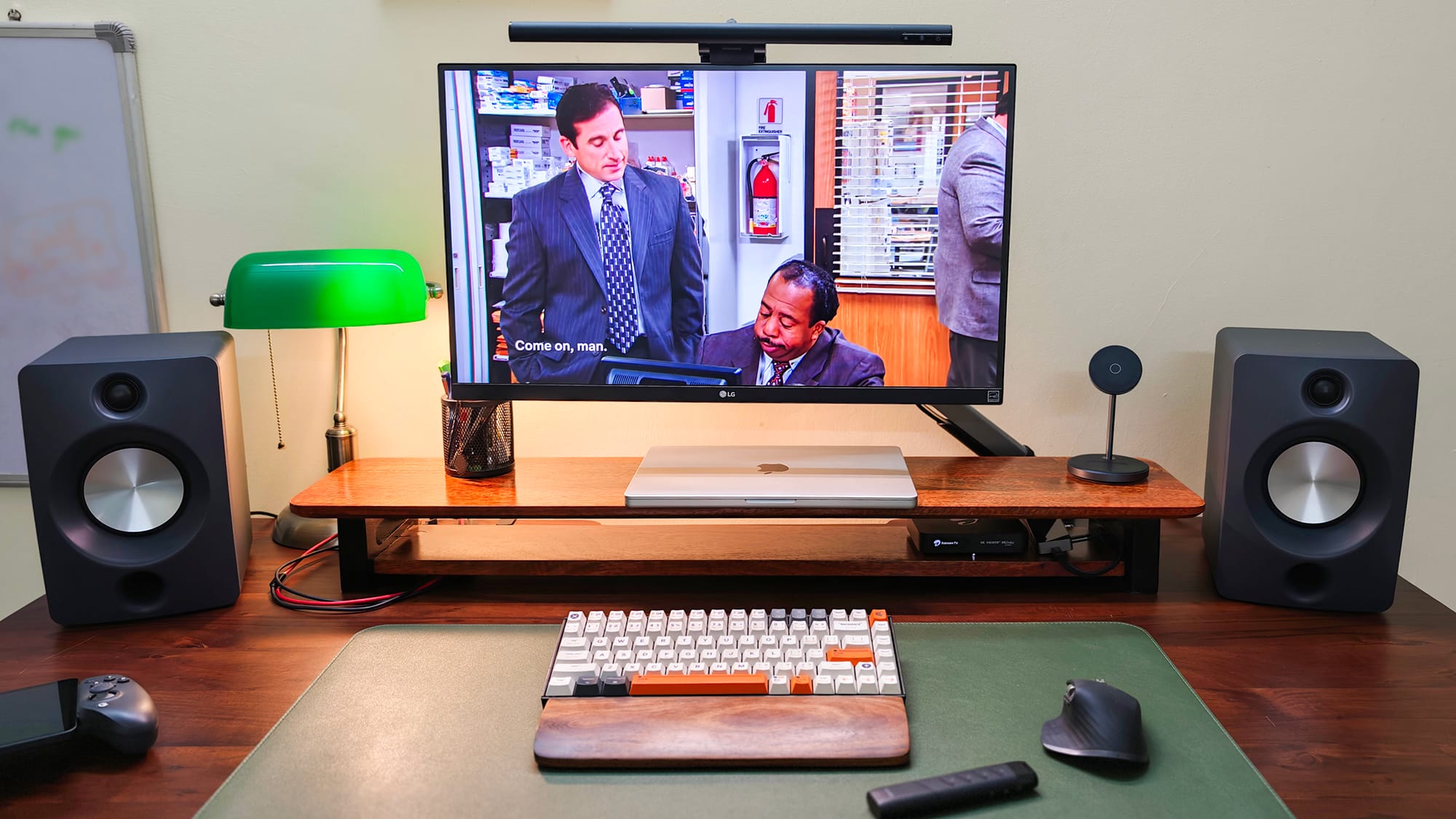
I lived with the Lumio Aura 5 speakers on my work desk, using them with a MacBook Pro and a Xiaomi 17 Ultra, and on my TV unit with the 55-inch Lumio Vision 9 QD-MiniLED TV I reviewed earlier.
Before I begin: Each cabinet pairs a 1-inch silk-dome tweeter with a 4.5-inch aluminium woofer, rated at 100W RMS.
The MRP is ₹22,999, with an introductory price of ₹19,999 on Amazon (inclusive of a ₹2,000 coupon. Lumio's web store takes ₹1,500 off for Diwali, and offers an additional 10% on ICICI cards.
Design and build
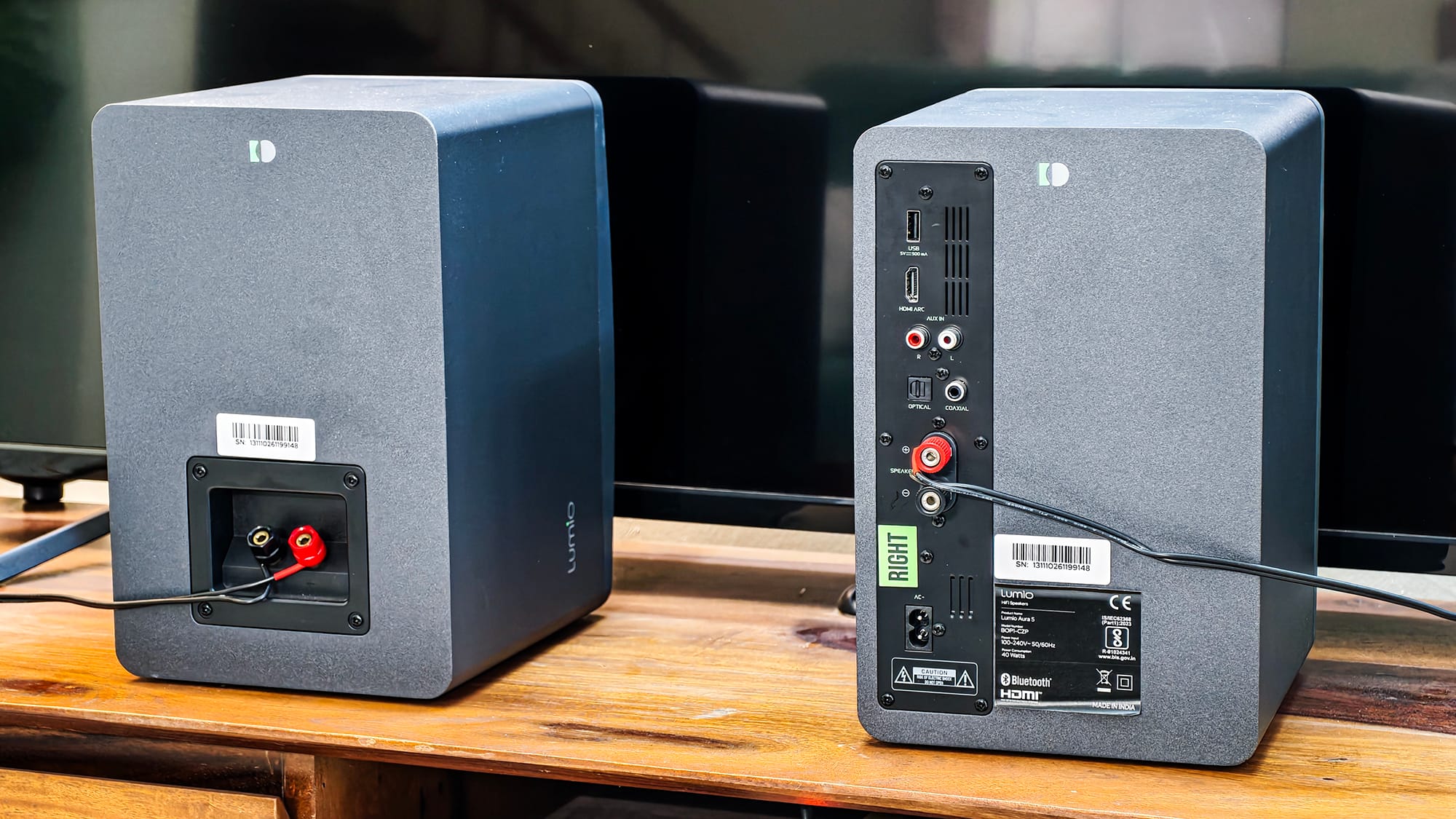
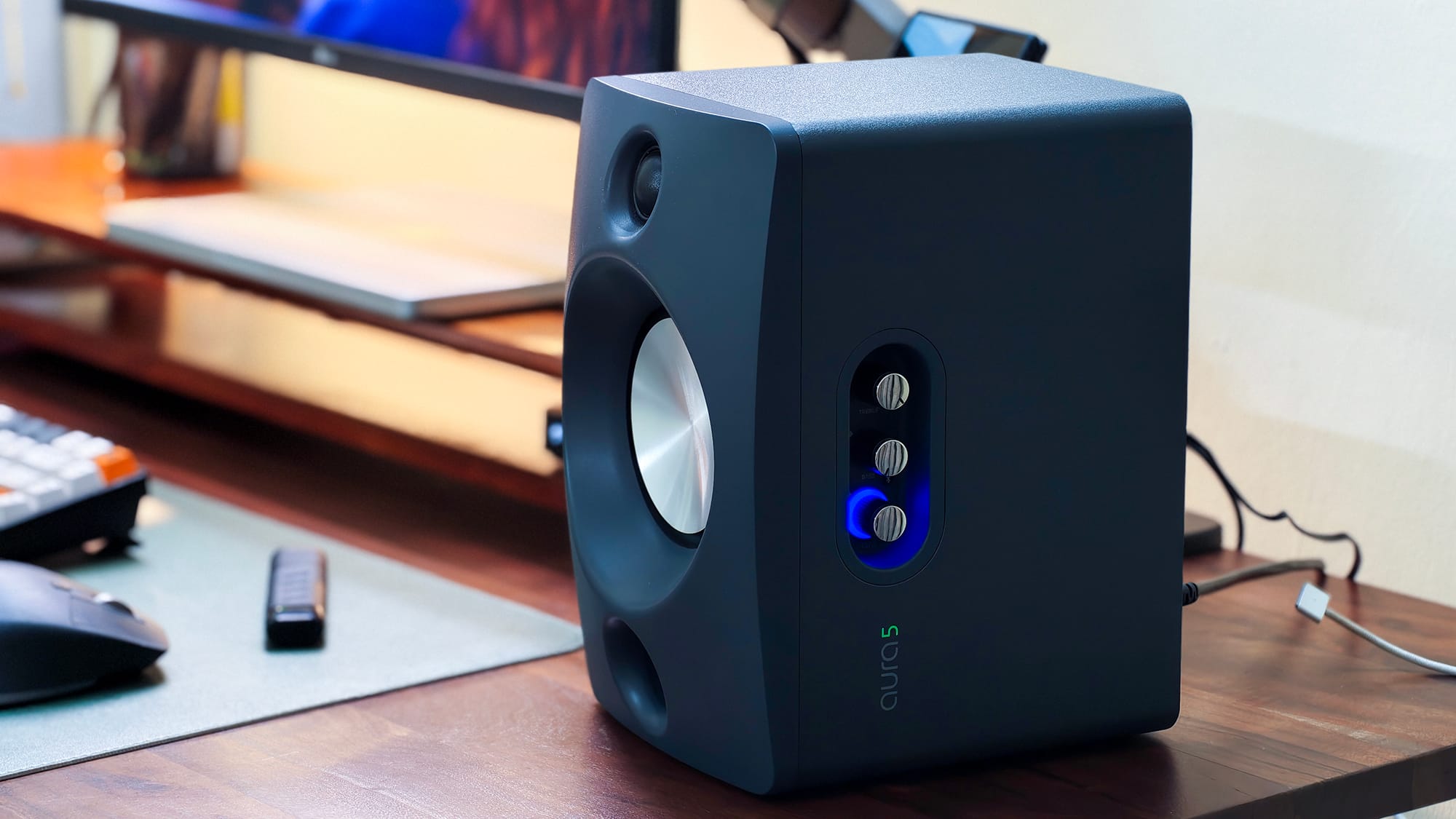
The Aura 5 speakers feel solid, and aptly heavy for their size. Each cabinet speaker measures 174 x 273 x 235mm, so you must plan for a deep desk, a wide-enough TV unit, or stands. The dark grey colourway has a sandstone-like texture with a subtle sheen.
The right speaker is active, while the left one is passive, linked by a 2-metre cable. The different configurations also mean the speakers weigh slightly differently — 3.1kg and 2.92kg, respectively. With this heft, the pair can be a mild hassle to move between rooms, but stays firmly planted once placed.
The active speaker on the right also houses three knobs in a carved-out area. These three chrome-plated knobs control bass, treble, and volume. Of the three, the volume knob also has a satisfying ratchet-like click and presses inwards for power on and off when you long-press it, or normally to switch the mode.
Audio: Excellent, mostly
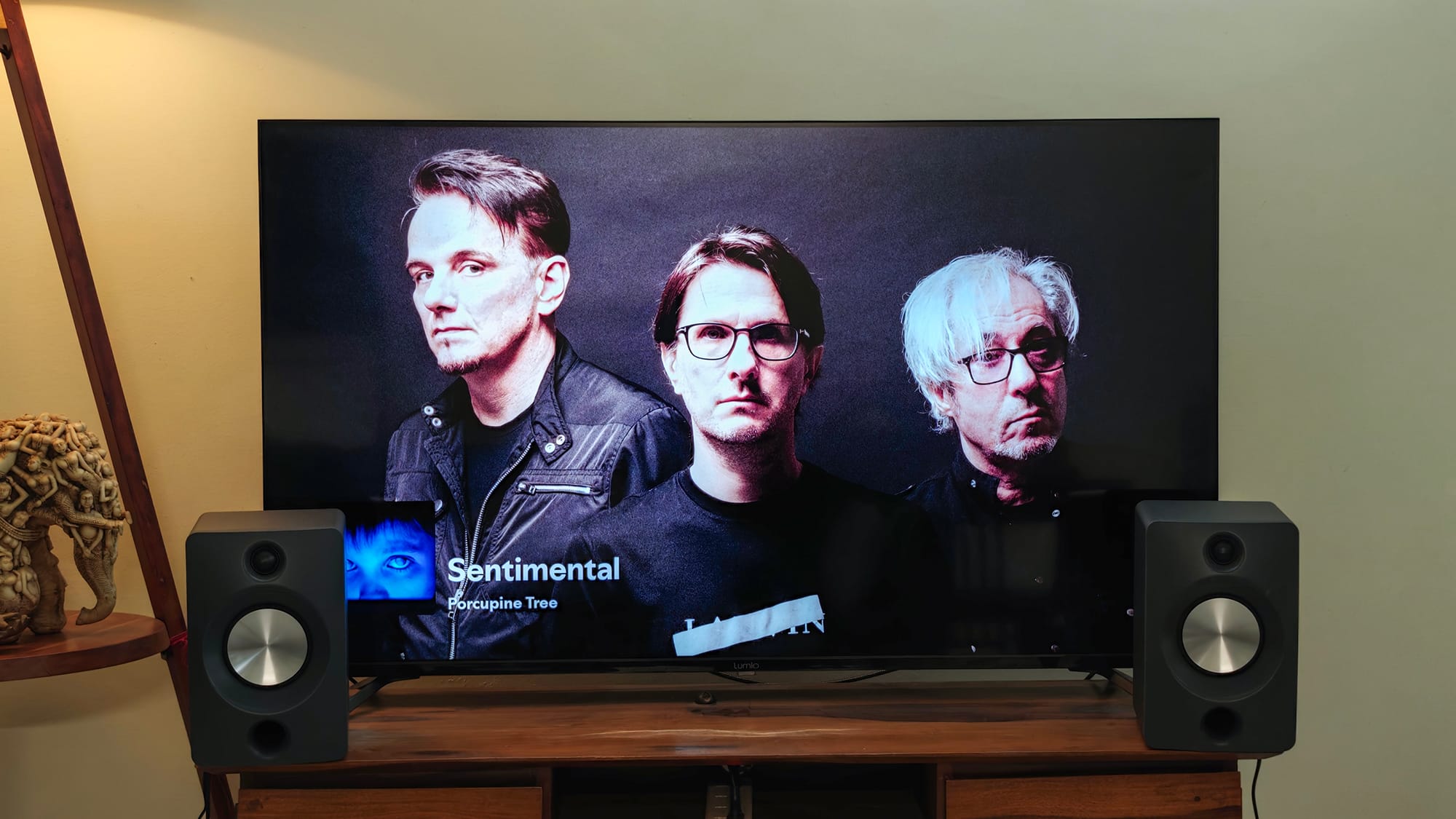
Up close, the Aura 5 sounds excellent. With the speakers 1.5 feet away and angled slightly towards me, it felt like listening to a good pair of IEMs. The sound wrapped around my head and was crisp, rich, and well-defined, and that was over Bluetooth from my MacBook.
Moving farther away to about 5 to 6 feet from the TV, clarity drops slightly but never turns muffled, on wired and wireless inputs alike. Switching from HDMI or optical to Bluetooth makes the difference more noticeable, but it won't mar your experience unless you're seeking duende and want each and every note to be discernible.
The bass is smooth and impressive. It doesn't thump like a subwoofer, but it never felt lacking, even in the bass-heavy opening of Dhurandhar 2. Prog rock and fusion blend smoothly, though metal fans may want more punch.
The pair effortlessly fills a 250 to 300 sq ft room, but the sound weakens through walls. Cheaper soundbars rated at 200W or 400W sound louder but less clear. Those ratings are often peak figures, while the Aura 5's 100W is RMS at 1% THD.
However, when I was within a reasonable distance, I heard no distortion from the Aura 5, even at full volume, which oddly tops out at 32 instead of 30 or another number in multiples of 5 or 10.
Connectivity: Diverse but with some challenges
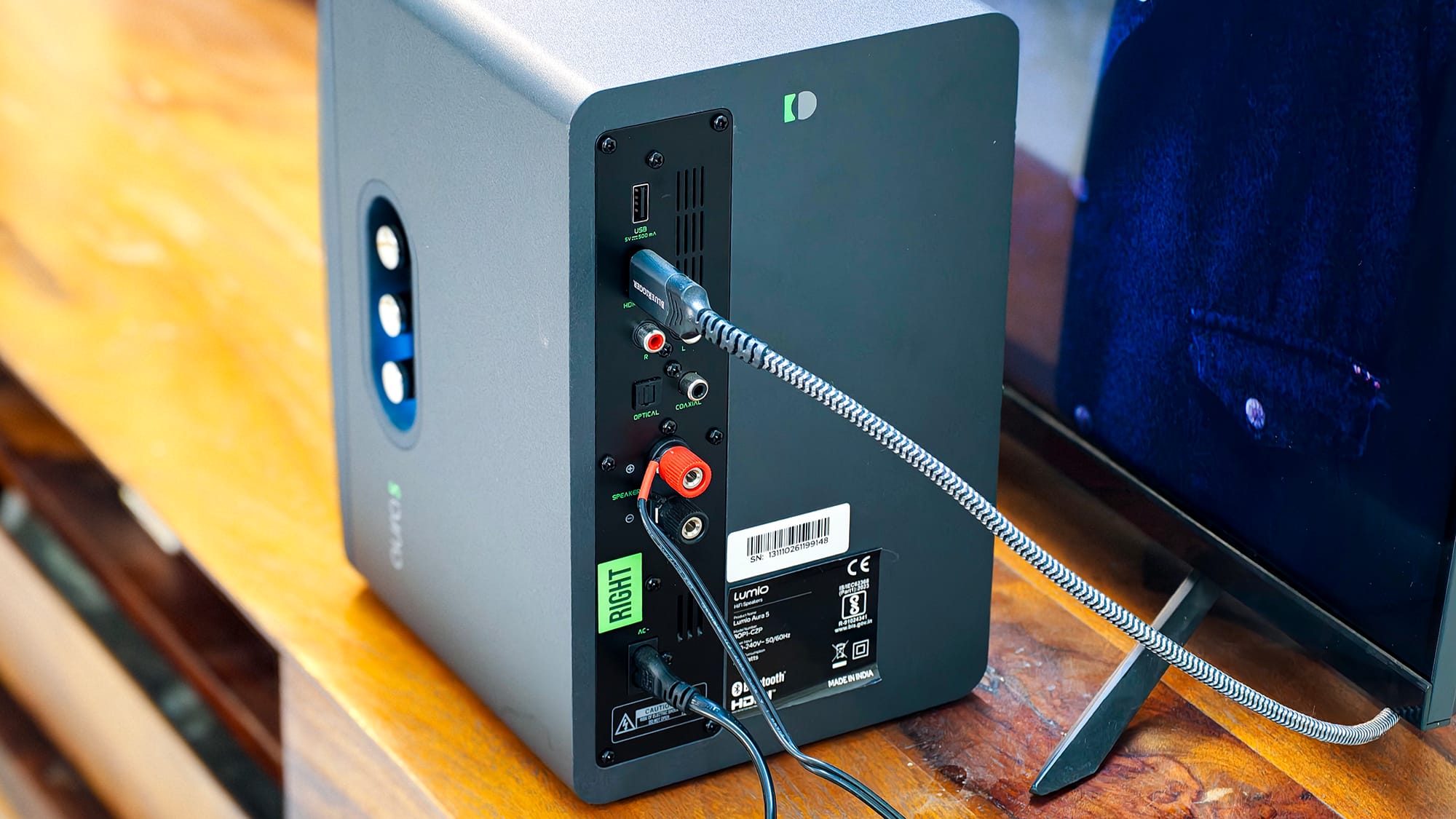
Lumio is generous with input options and offers HDMI 2.0 with ARC and CEC, optical, coaxial, RCA, USB-A with FLAC playback, and Bluetooth 5.4, up to 24-bit/48kHz. The spec sheet also mentions a 3.5 mm input, but you've got to use an RC-to-3.5 mm cable if you're planning to use that with laptops or PCs.
A ring around the volume knob changes colour with each input mode, which is a nice touch.
Among all options, HDMI ARC was my favourite, as it delivers high-res audio, while CEC eliminates the need to control volume separately on the TV (or another source) and the speakers — as optical and other traditional means require.
Among all options, Bluetooth feels like the weak link. It supports only SBC, with no AAC, aptX, or LDAC, which possibly explains the drop compared with wired inputs. For folks tuning in from their phones or tablets, this could feel like a miss for a product tagged "Your Audiophile journey starts here".
Another caveat is that it connects to one device at a time and reconnects only to the last paired one, so switching phones means re-entering pairing mode.
There is no Dolby decoding either. The TV decodes the audio and sends stereo PCM, mixing 5.1 soundtracks down to two channels.
Features: Sound presets and more
Of the three sound modes, Studio works best for both music and video, Cinema slightly lifts dialogue, and Groove boosts the bass and lower mids for music.
There is no companion app, which I find a bit irksome. I get the analogue-first appeal, but an app would allow finer EQ, especially since the bass and treble dials barely change the sound even at their extremes.
One, and perhaps the only true annoyance I have with these speakers is their power-on and Bluetooth pairing chimes, which play loudly regardless of the volume setting. Entering the Bluetooth pairing mode makes them repeat, and consequently even more annoying. Besides being annoying, it's occasionally startling — enough to wake up anyone sleeping in another room. (Don't ask me why I know!)
Over Bluetooth, the speakers sleep after 20 to 30 idle minutes to save power. The only status LED sits on the side, which makes it difficult to know the status in one go. A small indicator on the front would help with this.
Remote
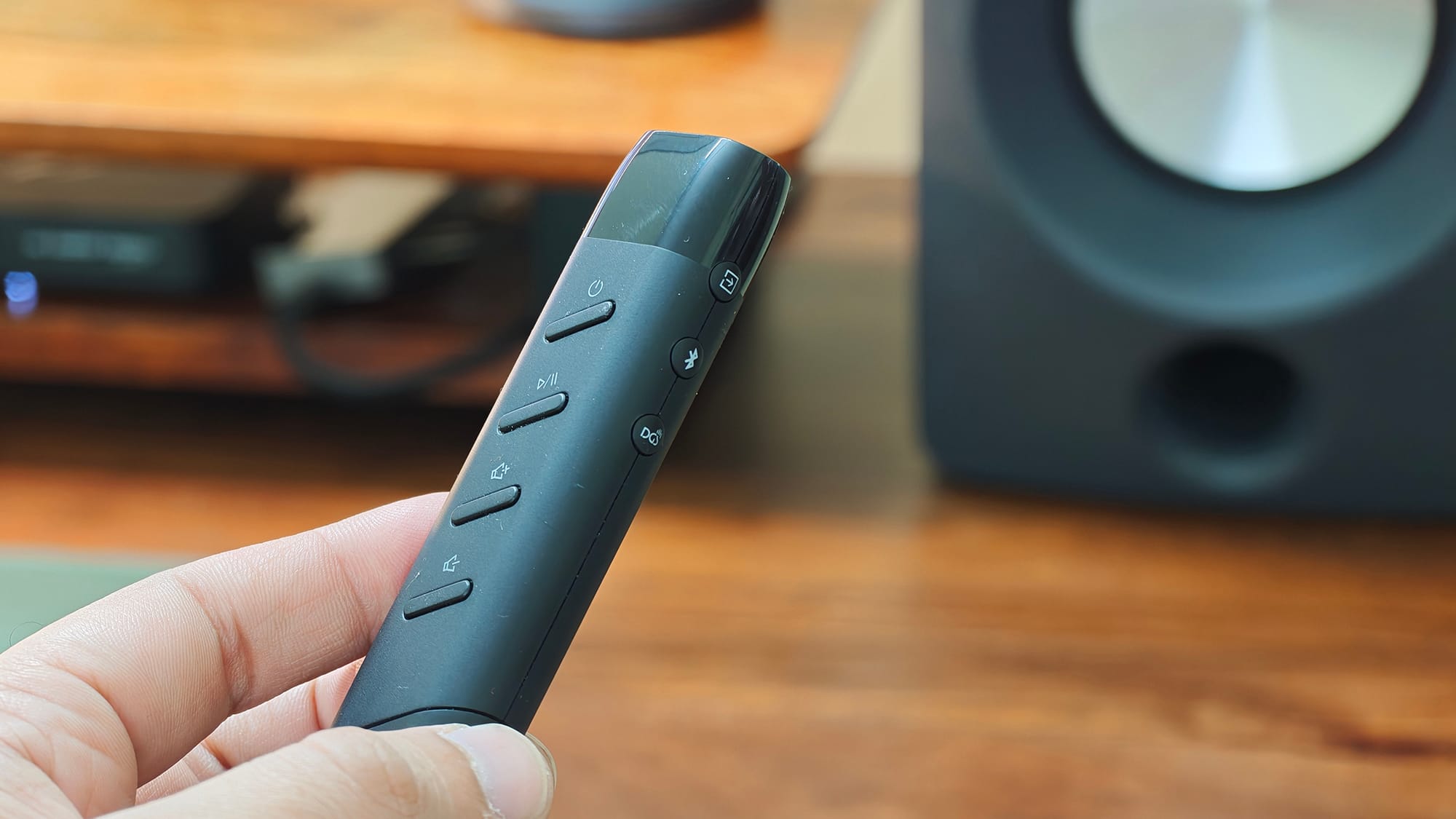
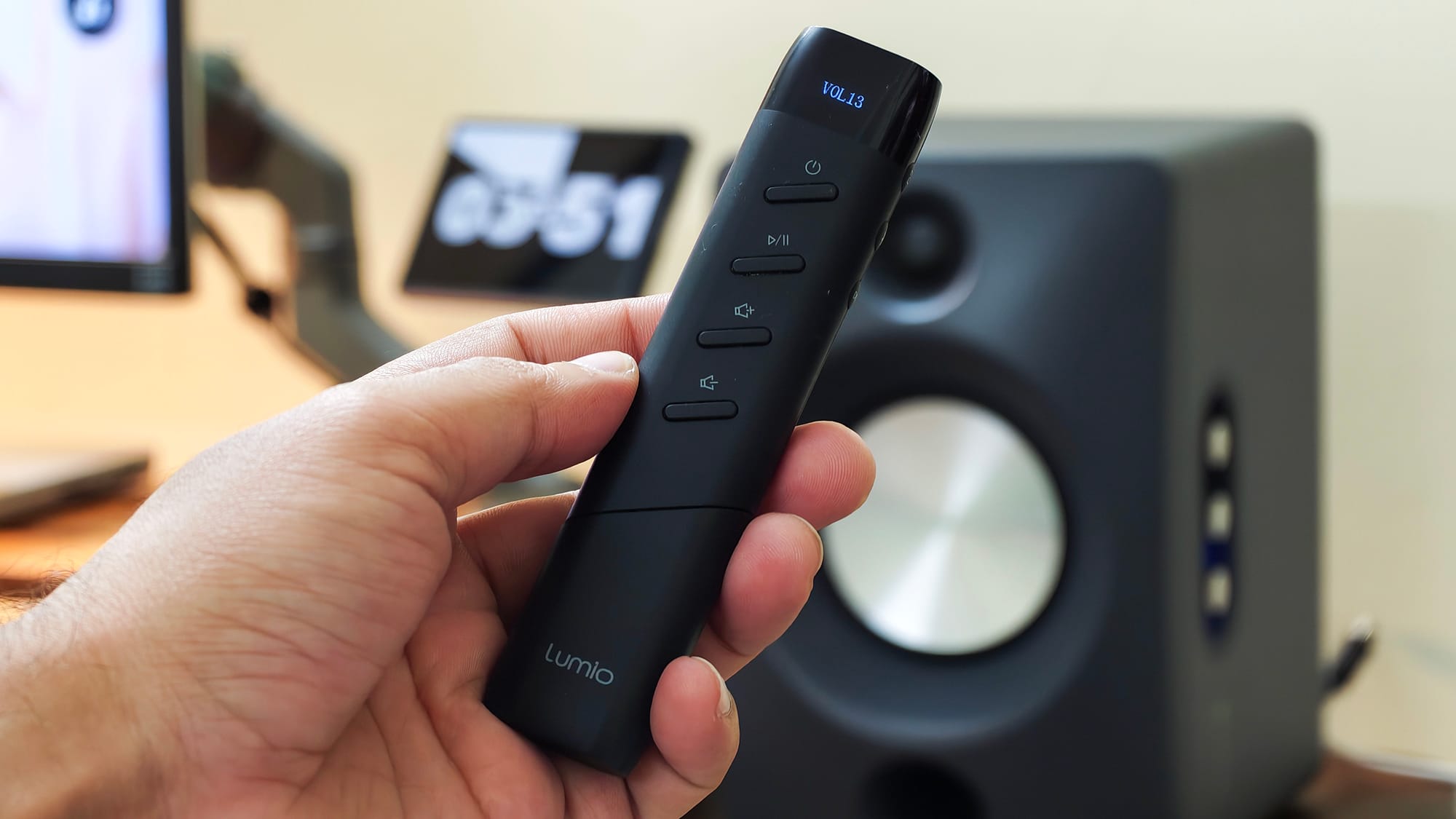
The Minion OLED remote is tiny and cute. Its display is useful when it comes to knowing the accurate volume or the input mode, and the buttons are easy to reach.
After a few idle minutes, though, it seems to go to sleep. Presses lag, so I would press again, and a couple of seconds later they all went through at once, overshooting the volume or cycling through modes like a rapid-fire.
Thankfully, the TV remote does most of the work over HDMI ARC, so I'm not overly reliant on the Minion remote.
Pros and cons
Pros
- Crisp, immersive near-field sound at a desk
- Smooth, well-integrated bass without a subwoofer
- No distortion, even at full volume
- Plenty of wired inputs, including HDMI ARC
- Solid build, ratcheted volume knob and colour-changing light ring
- Indian brand with an extensive service network
Cons
- SBC-only Bluetooth, one device at a time
- No Dolby decoding
- No 3.5mm input, despite the marketing
- No app, and the tone dials have little effect
- Loud chimes that ignore the volume setting
- Remote lags after sitting idle
- Bulky cabinets
Alternatives to Lumio Aura 5
While the Lumio Aura 5 offers impressive audio and a suite of connectivity options, there are some alternatives worth knowing.
- Edifier MR5 (₹22,990): This tri-amped 3-way pair adds a dedicated midrange driver, LDAC over Bluetooth 6.0, two-device multipoint, app EQ with room compensation, and balanced inputs. With no HDMI, optical or coaxial input, though, it suits a desk better than a TV.
- Sony HT-S400 (~₹16,000): For movie-first buyers, this front-firing 2.1 soundbar adds a wireless subwoofer, Dolby Digital decoding, and Night and Voice modes. Its Bluetooth is SBC-only, too.
I fully understand that it's difficult to compete with the large-scale manufacturing expertise of giants like Edifier or Sony, so I wouldn't judge the others solely for better value for money. What Lumio offers is the reliability of a consumer-focused Indian brand with extensive service support and great response times.
Should you buy or skip the Lumio Aura 5?
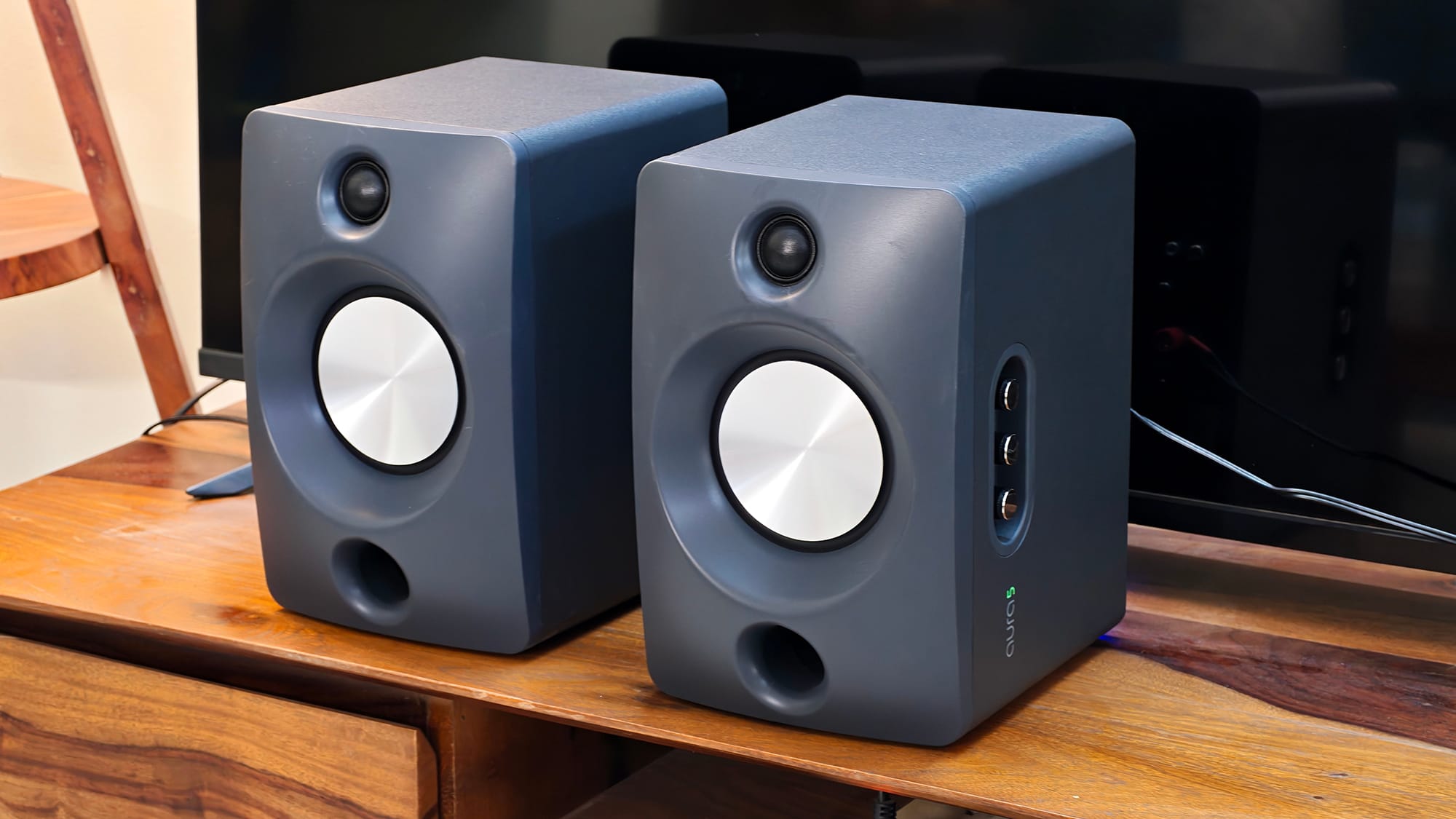
At ₹19,999, the Aura 5 is easy to recommend for desk-first listeners who also want a cleaner TV setup. Edifier offers more on paper, but Lumio is an Indian brand with an extensive service network and a well-regarded support reputation.
Buy if:
- You sit close to your speakers and want immersive, detailed stereo sound
- You mainly use HDMI ARC, optical, or coaxial, and want your TV remote to control volume
- You value local after-sales service
Skip if:
- You stream mostly over Bluetooth and want LDAC, multipoint or app EQ (consider the Edifier MR5)
- You want subwoofer-level bass and Dolby decoding for movies (consider the Sony HT-S400)
- Your desk or TV unit is short on space