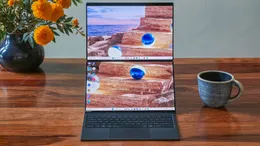

ASUS Zenbook Duo (2026) Review: Two Screens, One Very Confident Laptop
ASUS Zenbook DUO (UX8407AA) comes with dual 3K OLED screens, a shockingly good keyboard, and enough appeal to pick over a MacBook, despite its flaws. Read on to know why.
Tushar has spent more than a decade writing about technology, more than half of which has been spent cribbing, "where is that damn setting?" If money wasn't a thing, he would be a nomadic bard.
ASUS Zenbook DUO (UX8407AA) comes with dual 3K OLED screens, a shockingly good keyboard, and enough appeal to pick over a MacBook, despite its flaws. Read on to know why.
The ACEFAST Z9 is a 6-in-1 GaN charging station that aims to replace every brick and pad on your desk with a single matte-grey block. After months of using it as both a bedside dock and a travel charger, I think it largely succeeds, but has two caveats worth knowing before you buy.
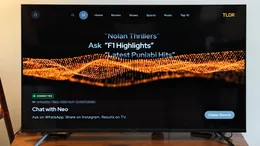
Lumio's Neo lets you search movies, shows, and highlights via WhatsApp and see results on a Lumio TV or projector. We tested it in the latest TLDR beta — here's what works and what doesn't.
The ASUS Zenbook S14 offers Intel's new Core Ultra 9 386H, a gorgeous 3K OLED, and a build you'll want to keep touching, but one weakness may be hard to miss.
The Lumio Vision 9 55-inch QD-MiniLED TV impresses with its blazing-fast Google TV performance, big room-filling audio, and strong contrast. Full review, pros and cons inside.
A Carnegie Mellon University study reveals starting your brainstorming process with Google can be detrimental to the group's creativity.
Teams relying much on search engines often produced inundatingly same, less original ideas due to a cognitive bias called "fixation effect," where seeing popular answers converges our thought process instead of diverging it.

While individuals weren't necessarily dumber with Google, groups of Google users seemed to get stuck in a rut, often coming up with the same common ideas, sometimes even in the same order! Talk about a copy-and-paste creativity crisis.
"This appears to be due to the fact that Google users came up with the same common answers, often in the same order, as they relied on Google, while non-Google users came up with more distinct answers," explained lead author Danny Oppenheimer.
EDITORS' PICKS